I first met the Donnert family in a circus in 2018. My travel companion was no other than circus doyenne Yasmine Smart. Yasmine knows anyone who is anyone in the traditional circus world and so we were sure of a good welcome. Elegant Elizabeth Donnert, the mother of this family, met us in the car park, neat in a floral dress and she kissed us hello. Under the shade of a red tent, caramel coloured camels chewed the cud and there were the peaks of mountains in the distance. Mrs Donnert and Yasmine spoke German together and as so often happens in circus outings one’s sense of place becomes confused. I had to think for a moment as to which country we were in, and then I remembered – Austria, and the circus was Louis Knie.
At the family’s caravans I met Romanian Emilie Sandulescu, the girlfriend of Tony Donnert (junior), one of Elisabeth and Tony’s five sons. Small, neat, show ready, she spoke fluent English interspersed with German and Hungarian. She explained that she had been studying economics at a university in Romania but was also studying dance. She worked on a show in the summer holidays and the Donnert’s had been looking for a replacement girl for the pas de deux (the act in our show Xanadu this summer where two people ride stacked balletically on two horses). She met and fell in love with Tony and has been with them for the last 12 years. I also met Tony, who had been busy rebuilding the horse box in his spare time as well as practising a wire act and keeping up the daily practise with their vaulting horses, under the instruction of his father Tony senior.
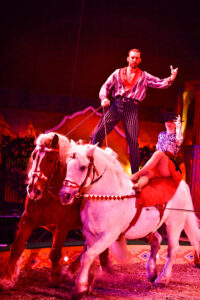
This is the thing about these type of circus people – they are so accomplished. Life is a nonstop process of skill development and so languages are learnt, bodies are trained, horses are brought on. In their spare time caravans are built and mended. New acts are developed, and costumes made. Tony Donnert’s sons have grown up on the road and have lived a life of nonstop travel, practise and shows. Their work is the result of almost military discipline. As teenagers and young people, they don’t go to Glastonbury for a week and come back and maybe get an internship or go travelling. They can’t afford the distraction of long weekends in the pub. Their work is incredibly dangerous, and they need to be in peak fitness in order to execute their high balances, standing forward somersaults on a cantering horse and horse to horse somersaults. On top of the training is the care and training of the horses themselves, to whom the family are devoted. Their two Hungarian draft horses and two Percherons are looked after immaculately, and are daily groomed, exercised or put out to graze in large paddocks. The whole family shares this work between them.
This is a love letter to the Donnert family because as always in the years I have worked in the circus I am amazed by the humility of these people. They are reserved, shy people, completely uninterested in celebrity for the sake of it, going daily to their work with a sort of dutiful patience. When they perform their act is jaw dropping, the brothers, wives, horses and Tony Donnert Senior a picture of dynamic complicity. Tricks that if missed could result in shattered bones or worse. Work that is at the heart of the development of circus – to watch a person standing on a horse galloping in a circle – this takes us right back to Phillip Astley and probably beyond, the simple thrill of the galloping horse and the balancing person – the risk, the glamour, the brio , the macho, the poetry, the zen. Yet as people they are understated, slow to open to strangers, and with absolutely no boast or brag.
This is a love letter to the Donnert family because I am so horrified and so sad by the people who conclude that they must be cruel to the horses. These people live for their horses. They live, like true nomadic stock people, right beside their animals so that they can hear in the night if one of the horses is upset. The horses want for nothing and have a life that is a perfect balance of work and rest, all held in a routine that is upheld by the family all hours. The horses are chosen for their immense strength – they are draft horse bred to drag timber of plough heavy earth. The family are all feather weight and move lightly, like dancers. Their retired horse, Jumper, that they keep with them, is twenty-four and sound – a testament to a life of good care. Besides this – these are working horses. Far from cruel, the Donnerts are preserving a tradition and a place for the working horse. I wonder what the people who think this is cruel would like these horses to be doing? In the wild? – what wild? These horses have been bred for centuries for work. If they were working then their immense strength and power would be being harnessed to haul heavy loads, and if they were kept simply as horses to be admired they would need a rich patron to provide for them – they eat an immense amount of hay and hard food as well as needing regular vaccinations, worming and visits from the farrier and dentist. All this is provided by the Donnerts, and in return the horses work for the family, hard, but not unduly hard. It is the perfect partnership. I feel that the ‘cruel’ accusation is more a type of reflex discrimination, a down right dislike of circus work.
One of the Donnert’s sons has Downs Syndrome. Like the other boys he has lived an outdoor physical life and he works with his brothers. We did a display for the local Riding for the Disabled Group and Alfons showed the assembled group a kind of light comedy routine with the retired horse. Alfons and his old partner, snowy white Jumper, playing together in the ring was one of the most touching things I have ever seen in a circus, and encapsulated for me the Donnerts life of compassion, understanding, inclusivity and commitment to family and animals.
The Donnert family are one of three families who still do this work, worldwide. They are rare and to be treasured.
This article first appeared in Backstage magazine published in October 2019